



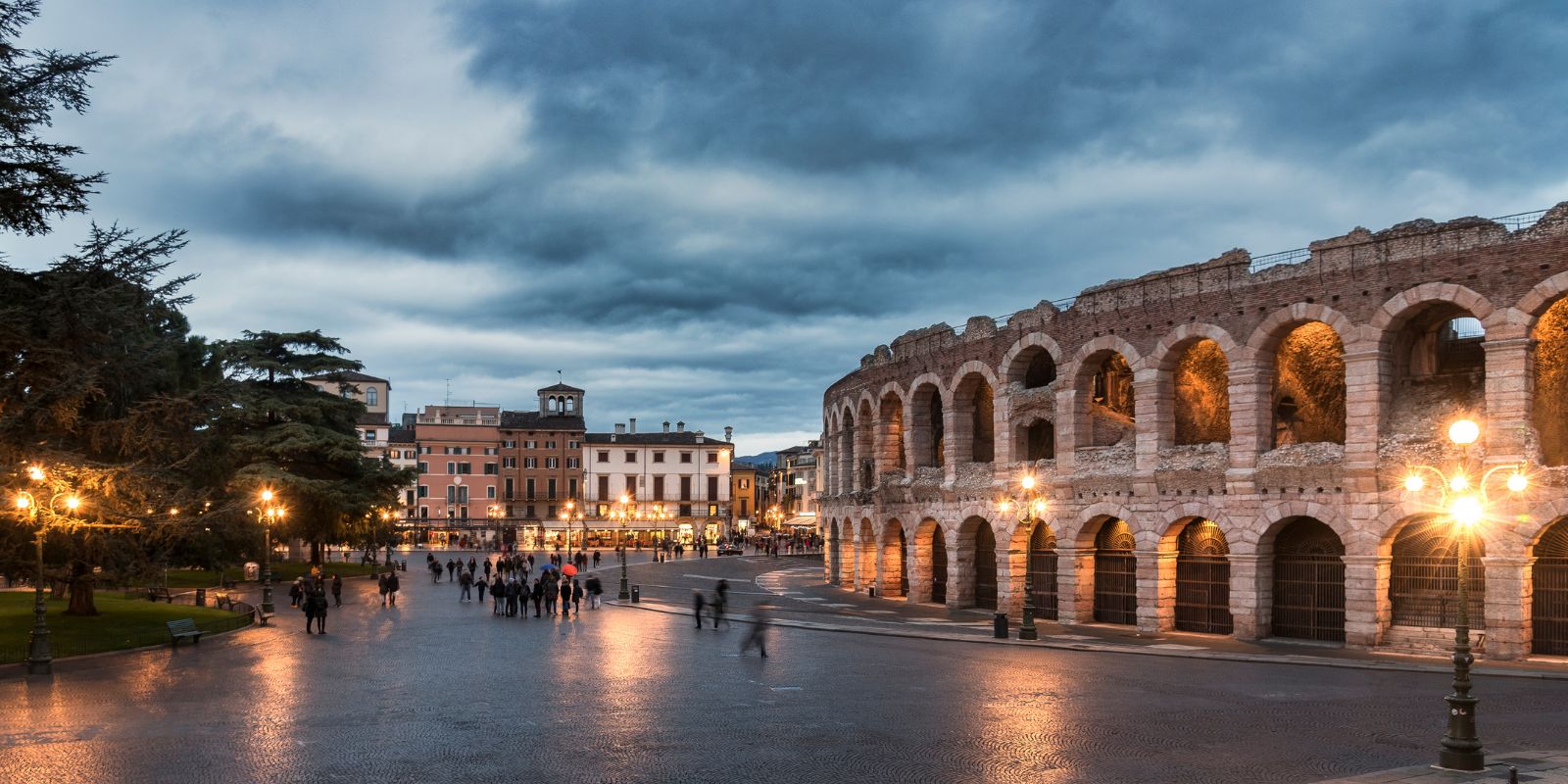
Verona
VERONA (situated ca. two hours by car from here) this city
is still very medieval in appearance. Looking down
from the large square of Castle San Pietro, however,
the city stretches out towards the south, the roads
are strikingly straight and regular - particularly
where there are groups of houses together. This
shows us that the underlying structure is Roman
rather than medieval.
You will admire:
- Arche Scaligere: the
walled cities of the Veneto have already been discussed:
Verona is undoubtedly the most important of these.
The city's greatest historical moment was when Cangrande
gave hospitality to Dante Alighieri and kindled
its Ghibelline dreams of the restoration of the
Empire. Cangrande extended the seigniory of the
Della Scala family to nearly all of the Veneto region.
The Arche give the appearance of an ornamental garland,
mixed in as they are with the vines and the olive
trees miles from the town center, although in fact
they bear witness to the ambitions, the glory and
the period of Verona's greatest expansion;
- Statue of Cangrande on horseback: sheltered today in the museum of Castelvecchio,
it's one of the very first European statues to use
equestrian poses for their subject matter;
- Castelvecchio bridge: the imaginative and functional
bridge at Castelvecchio was also built at this time,
thought for civic and military purposes. This, like,
for that matter, the castle at Castelvecchio, was
the most complex and conspicuous of a series of
fortifications which still surround large stretches
of Verona;
- S. Zeno church: the
city was made so beautiful by the works of the fourteenth
century that it's almost possible to overlook those
preceding this period. The most striking of these
is the church of San Zeno, the town's most important
place of worship on account of its great age and
the fact that it's adorned with the name of the
city's patron saint. As well as the design of the
church itself, we can also admire its bronze doors,
a masterpiece of Romanesque sculpture. Several artists
worked together to endow these with the genial,
barbaric and distant echoes of classical times as
well as a forceful streak of medieval creative values
- the sense of despair of the latter struggling
to find concrete forms. There is also a wonderful
triptych by Mantegna, a masterpiece of the Renaissance,
hanging above the main altar of the church;
- Dante square: its definitely
the most aristocratic of all squares in the city.
It's faced by an elegant Loggia, the Palazzo del
Comune and the famous Tombs;
- Erbe square: it embodies
all the flair and imagination typical of a trading-place
of the populace and it is watched over by the statue
of Madonna di Verona which the Veronese hold particularly
dear. The square is naturally also attractive for
its stalls, for the people who go there and for
the traffic that winds through it: in short, for
its soul, which belongs to the people;
- The Arena: it's also the
Veronese who give to the performances of the Arena
that inimitable tone, and which attract never ending
crowds of spectators to the city of the Della Scala
family - the magnificence of the Roman ruins, the
perfection of the staging and the musical shows
would not suffice on their own. The Arena is for
the Veronese not simply a show, but a rite.
- S. Giorgio church:it's
also attributed to Sanmicheli, a fortress builder
who worked at several of the most imposing Palaces
of the city. S. Giorgio is a major landmark in the
layout of the town.
In the province of Verona
- Pedemonte: the Veronese
hills are crowded with villas, as is the case with
all the Piedemontese area. One of the most striking
of all of these, In Piedemonte itself, was the work
of Palladio. He built it very late on in life using
an exceptionally simple double colonnade and extreme
simplification of the structures;
- Negrar: houses the
Rizzardi villa which has a seventeenth century garden
with a theatre added to it by Trezza in the eighteenth
century.
- Soave: its walls
climb up the hills, watched over by the oldest and
highest of castle towers, the final refuge if their
enemies managed to get through the external defense.
VERONA (situated ca. two hours by car from here) this city is still very medieval in appearance. Looking down from the large square of Castle San Pietro, however, the city stretches out towards the south, the roads are strikingly straight and regular - particularly where there are groups of houses together. This shows us that the underlying structure is Roman rather than medieval.
You will admire:
- Arche Scaligere: the walled cities of the Veneto have already been discussed: Verona is undoubtedly the most important of these. The city's greatest historical moment was when Cangrande gave hospitality to Dante Alighieri and kindled its Ghibelline dreams of the restoration of the Empire. Cangrande extended the seigniory of the Della Scala family to nearly all of the Veneto region. The Arche give the appearance of an ornamental garland, mixed in as they are with the vines and the olive trees miles from the town center, although in fact they bear witness to the ambitions, the glory and the period of Verona's greatest expansion;
- Statue of Cangrande on horseback: sheltered today in the museum of Castelvecchio,
it's one of the very first European statues to use
equestrian poses for their subject matter;
- Castelvecchio bridge: the imaginative and functional bridge at Castelvecchio was also built at this time, thought for civic and military purposes. This, like, for that matter, the castle at Castelvecchio, was the most complex and conspicuous of a series of fortifications which still surround large stretches of Verona; - S. Zeno church: the city was made so beautiful by the works of the fourteenth century that it's almost possible to overlook those preceding this period. The most striking of these is the church of San Zeno, the town's most important place of worship on account of its great age and the fact that it's adorned with the name of the city's patron saint. As well as the design of the church itself, we can also admire its bronze doors, a masterpiece of Romanesque sculpture. Several artists worked together to endow these with the genial, barbaric and distant echoes of classical times as well as a forceful streak of medieval creative values - the sense of despair of the latter struggling to find concrete forms. There is also a wonderful triptych by Mantegna, a masterpiece of the Renaissance, hanging above the main altar of the church;
- Dante square: its definitely the most aristocratic of all squares in the city. It's faced by an elegant Loggia, the Palazzo del Comune and the famous Tombs;
- Erbe square: it embodies all the flair and imagination typical of a trading-place of the populace and it is watched over by the statue of Madonna di Verona which the Veronese hold particularly dear. The square is naturally also attractive for its stalls, for the people who go there and for the traffic that winds through it: in short, for its soul, which belongs to the people;
- The Arena: it's also the Veronese who give to the performances of the Arena that inimitable tone, and which attract never ending crowds of spectators to the city of the Della Scala family - the magnificence of the Roman ruins, the perfection of the staging and the musical shows would not suffice on their own. The Arena is for the Veronese not simply a show, but a rite.
- S. Giorgio church:it's also attributed to Sanmicheli, a fortress builder who worked at several of the most imposing Palaces of the city. S. Giorgio is a major landmark in the layout of the town.
In the province of Verona
- Pedemonte: the Veronese hills are crowded with villas, as is the case with all the Piedemontese area. One of the most striking of all of these, In Piedemonte itself, was the work of Palladio. He built it very late on in life using an exceptionally simple double colonnade and extreme simplification of the structures;
- Negrar: houses the Rizzardi villa which has a seventeenth century garden with a theatre added to it by Trezza in the eighteenth century.
- Soave: its walls climb up the hills, watched over by the oldest and highest of castle towers, the final refuge if their enemies managed to get through the external defense.